Ask your team what your battery pack should cost. Then watch the room go quiet.
Not the price on the quotation. The cost. Subsystem by subsystem, before anyone opens a negotiation. That silence has a price, and most OEMs are already paying it.
The problem nobody names
Mustafa Şimşek, the founder of eMOBINO, came back to Türkiye in June after five years inside the Asian battery industry. Since then, one problem has stood out across Turkish and European OEMs more than any other. Not range. Not charging. Not software. The battery cost.
A quotation can be fully justified. It can also carry risk premium, margin, unnecessary complexity and intermediary cost that nobody on the buyer side can quantify. When the buyer pushes back, one sentence usually covers all of it: your volume is too low.
Low volume does carry a premium. That part is true. But if nobody in your organisation can calculate what that premium should be, it stops being a premium and becomes a blank cheque.
This is not a purchasing problem
It is a battery cost engineering problem, and the two are handled by different people with different tools.
Purchasing compares offers. Cost engineering builds the number the offers should be compared against. Without that number, every quotation is judged only against other quotations, and the supplier who set the anchor wins the negotiation before it starts.
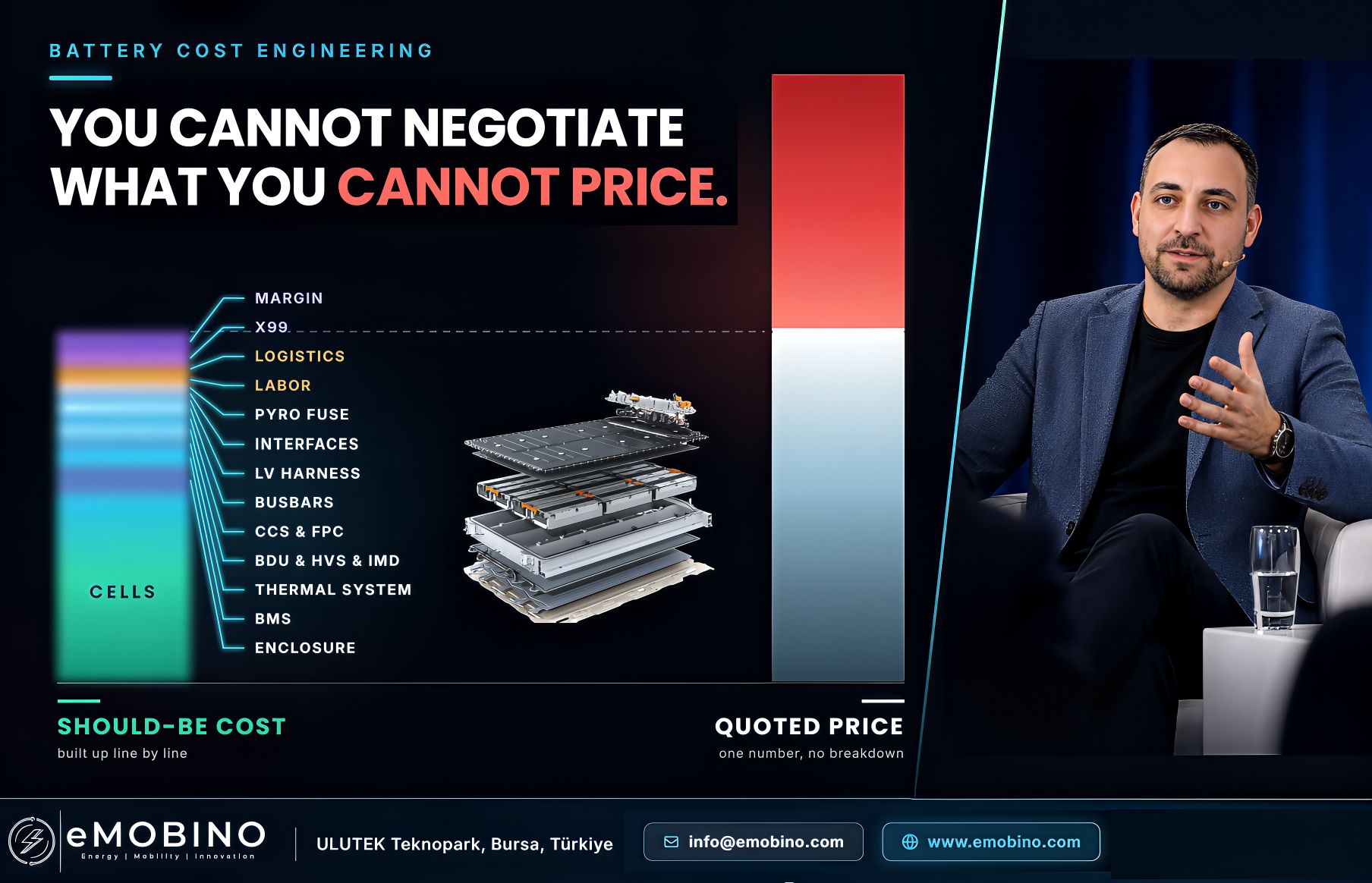
A pack is not one line item. Its should-be cost is built up line by line, and each line has its own drivers.
What a pack should cost, subsystem by subsystem
- Cell economics. LFP or NMC, and behind that the lithium, nickel and graphite indices. Cell cost moves with the commodity curve, and a quotation frozen at last quarter's index is already wrong.
- Architecture. Cell format, module-to-pack, cell-to-pack or cell-to-chassis, and the scale economics each one unlocks. Architecture decides how many parts exist before anyone prices a single one.
- Housing and top cover. Material choice, structural concept, interfaces and IP class. Aluminium extrusion, steel stamping and composite each carry a different tooling and cycle-time story.
- BDU and busbars. Contactors, fuses and pyro fuse, copper or aluminium HV distribution. Copper prices move; the decision to use aluminium busbars is a cost decision made in engineering, not in purchasing.
- BMS and sensors. Hardware, LV harness, Hall sensors or shunts, CCS and FPC, and the redundancy concept. Redundancy is where safety requirements silently double a subsystem.
- Thermal management. Cooling architecture, inlets, vents and assembly complexity. A cold plate is cheap; the labour to integrate it without leaks is not.
- Compliance. The real cost of functional safety, cybersecurity, certification and customer-specific requirements. This line is the one most often missing from the buyer's model and most often padded in the seller's.
Add labour, logistics and margin on top, and you have a should-be cost. Now, and only now, a quotation can be read.
Where the padding hides
When a quotation lands well above the should-be cost, the excess is rarely in one place. It is spread across four layers that each look reasonable on their own.
- Risk premium on unproven volume. The supplier prices your ramp-up risk into every unit, then keeps that price after the ramp is done.
- Intermediary layering. A trading company, an agent and a local integrator each add margin to a cell that was priced once at the factory gate.
- Over-specified compliance. Requirements copied from a previous programme, certified again at full cost, whether or not your application needs them.
- Change reserve. An unstated allowance for the engineering changes the supplier expects you to make because your specification arrived incomplete.
None of these show up as a line on the quotation. All of them show up in the gap between the quotation and a cost model built from the engineering side.
Three quotes do not establish the right cost
Without a should-be cost model, procurement falls back on protocol. Three quotes, take the lowest, hope it is fair.
But three quotes do not establish the right cost. They establish the lowest price offered by the suppliers you happened to ask. If all three anchored on the same assumptions, the lowest one is still expensive. That is not cost engineering. That is buying in the dark.
We tested the gap
One RFQ, two approaches, same specification, same annual volume, same certification scope.
Side A. An experienced purchasing team ran it through standard channels. Side B. Our founder ran it from the engineering side, through direct channels in Asia.
What came back on Side B was close to half of Side A's number.
The gap did not come from a trick. It came from knowing how a pack is built, what each subsystem should cost, and who actually builds it. No intermediaries, no layer of risk premium on top of risk premium.
What this means for your next RFQ
Before the next RFQ becomes a purchase order, ask the room one more time: do we know what this pack should cost?
If the answer is silence, the negotiation is already lost, whatever the final discount looks like. The fix is not a harder negotiator. It is a number built from the engineering side that the negotiator can stand on.
Battery cost engineering at eMOBINO
Our core work is IP-driven product development and advanced engineering. On top of that we run a battery cost engineering practice for OEMs and pack buyers.
- Should-be cost modelling and target cost setting.
- Subsystem-level quotation validation against that model.
- Design-to-cost and lifecycle cost optimisation.
- Alternative Tier-1 supplier scouting and direct sourcing.
Chemistry, pack energy, annual volume. Three lines are enough to tell you whether your number is real.
info@emobino.com
The visual
Should-be cost built up line by line, against a quoted price that arrives as one number with no breakdown.
References
- ISO 26262, Road vehicles, Functional safety.
- ISO/SAE 21434, Road vehicles, Cybersecurity engineering.
- UN Regulation No. 100 and UN GTR No. 20, electric powertrain and EV safety requirements.
- BloombergNEF, Lithium-Ion Battery Price Survey, annual.