
Europe is not adding a label to batteries. It is adding a memory.
Under the EU Battery Regulation (EU) 2023/1542, the European Union is introducing its first Digital Product Passport to enforce circularity and provenance. Batteries go first, and they set the technical benchmark that every other product group under the Ecodesign for Sustainable Products Regulation (EU) 2024/1781 will inherit.
The date that matters is 18 February 2027. From that day, an EV battery, a light mobility battery or an industrial battery above 2 kWh cannot legally enter the EU market without a verified digital passport behind it.
This article breaks down what the regulation actually requires, what it does not require, and the five questions that decide whether your 2027 roadmap is real or aspirational.
Every battery has a physical life. Now it needs a digital data trail.
The passport is not one document. It follows the product through five stages, and each stage has an owner who has to produce verifiable data.
- Material provenance. Mining origins of lithium, nickel, cobalt and graphite, with OECD-aligned ESG due diligence behind the claim.
- Manufacturing carbon. A certified cradle-to-gate life cycle assessment, carried as a verifiable carbon footprint value rather than a marketing number.
- Service and diagnostics. Module disassembly instructions, safe repair protocols and open fault codes that a third-party workshop can actually use.
- Cascade deployment. State of health history detailed enough for a second-life integrator to price and repurpose the pack into stationary storage.
- Closed-loop recovery. Chemistry breakdown at a level that lets a hydrometallurgical recycler plan recovery against mandatory recycled content quotas.
The regulation has a structural effect. It forces fragmented supply chain data, today scattered across a cell supplier, a pack assembler, an OEM and a service network, into a single verifiable digital asset with one accountable owner.
A QR code is not a passport
This is the most expensive misunderstanding in the market right now.
The QR code is the physical entry point. The passport is the verified, auditable data layer behind it. Printing a code and pointing it at a landing page satisfies nothing.
A compliant passport does four things at once.
- Identity. It uniquely identifies every individual pack, not the model, through GS1 Digital Link and W3C-compatible unique identifiers.
- Traceability. It carries verified material chemistry, carbon footprint and mineral origin data.
- Compliance. It makes Notified Body audit evidence and CE conformity digitally verifiable rather than filed away in a PDF archive.
- Circularity. It provides the safety and composition data that second-life integrators and recyclers legally need before they can touch the pack.
Compliance is not an IT procurement problem
The most common assumption inside manufacturers right now is that the passport is a software line item. Buy a platform, connect it to the ERP, close the topic.
It does not work that way. Because batteries set the blueprint for the entire DPP framework, compliance rests on four pillars that no vendor can supply on your behalf.
- OECD due diligence. Traceable mineral provenance across Tier-1 and Tier-2 suppliers, documented well enough to survive an audit.
- Certified carbon footprint. Cradle-to-gate LCA data a Notified Body can verify, not an internal estimate.
- Dynamic BMS telemetry. State of health history maintained across the pack lifetime, so second-life cascades stay commercially possible.
- Tiered access control. Proprietary chemistry IP protected while open compliance data stays publicly readable.
Each of these is an engineering and data governance decision before it is a software decision. That is why this deadline is harder than it looks.
This did not happen overnight
The 2027 deadline is the end of a regulatory pipeline that started in 2019, not a surprise.
- 2019 to 2020. The European Green Deal sets the direction in December 2019, the Circular Economy Action Plan follows in March 2020, and in December 2020 the Commission proposes replacing Directive 2006/66/EC.
- July 2023. Regulation (EU) 2023/1542 is published in the Official Journal.
- June 2024. Regulation (EU) 2024/1781 establishes the wider cross-sector DPP architecture through ESPR.
- July and August 2026. The EU DPP Registry opens on 20 July and Implementing Regulation (EU) 2026/1778 enters into force on 6 August. Article 13 printed labelling for all batteries applies from 18 August.
- 18 February 2027. The full Battery Passport under Article 77 becomes mandatory for EV, LMT and industrial packs in scope.
The registry is no longer theoretical. The test environment is live, the implementing rules are published, and the compliance clock is already running.
Why batteries went first
Because a battery is not one product. It is four problems stacked on top of each other.
- High value and geopolitical sensitivity. Critical minerals are concentrated outside Europe. Tracking their origin and recovery is an industrial policy objective, not an environmental gesture.
- An active high-voltage machine. Unlike a passive product, a battery changes. It degrades with thermal history, voltage exposure and charging behaviour, which means its data is never static.
- Cascade economics. An EV pack retired at around 75 percent state of health is a valuable asset for stationary storage long before it becomes recycling feedstock. That transaction is impossible without trustworthy history.
- Safety. Nothing else in a vehicle carries this much stored energy, and nothing else needs this level of dismantling data at end of life.
Solve the data problem for batteries and you have solved the template for textiles, electronics, steel and construction products.
Who is in scope from 18 February 2027
- Electric vehicle batteries. Traction batteries for passenger cars (M1), commercial vans (N1), heavy trucks and buses.
- Light means of transport batteries. Sealed batteries weighing 25 kg or less that power e-bikes, e-scooters and other light electric mobility.
- Industrial batteries above 2 kWh. Stationary energy storage, automated guided vehicles and telecom backup systems.
The critical distinction, and the one most teams get wrong: all batteries require a QR code from that date, but only batteries in scope lead to a full Digital Battery Passport. Confusing the two produces either an under-built system that fails an audit or an over-built system that burns budget for nothing.
One QR code, tiered visibility
A frequent objection is that the passport exposes proprietary chemistry to competitors. It does not, and the architecture is explicit about it.
Public access, open to anyone who scans the code, covers manufacturer and commercial model, basic chemistry and capacity, carbon footprint, recycled content shares and the safety data sheet.
Restricted access, granted only to verified roles such as Notified Bodies, repairers, second-life integrators and recyclers, covers cell-level bill of materials and mineral origin, dynamic BMS telemetry and state of health, pack dismantling and repair manuals, critical metal recovery quotas and audit evidence.
Access varies by verified role. Commercially sensitive intellectual property is never public by default. The engineering problem is not disclosure. It is building an access control layer that can prove who saw what, for ten years.
Four myths that cost money
"The full Digital Battery Passport has been mandatory since August 2026." No. General labelling rules and registry testing are active. The full passport under Article 77 takes effect on 18 February 2027.
"The passport requires continuous 24/7 telemetry streaming from every vehicle." No. Periodic synchronisation is sufficient. Updated state of health and lifetime metrics are required. A live stream is not.
"Blockchain is legally mandated by the European Commission." No. The framework is technology neutral. What is required is open interoperable standards such as JSON-LD and Asset Administration Shell, plus decentralised registry compatibility.
"Uploading a static PDF or a scanned test report behind a QR code is sufficient." No. The data must be machine-readable and structured, and synchronised with the central EU DPP Registry.
Each of these myths pushes a programme in a different wrong direction. Two of them cause overspending on architecture nobody asked for. The other two cause a compliance gap discovered too late to fix.
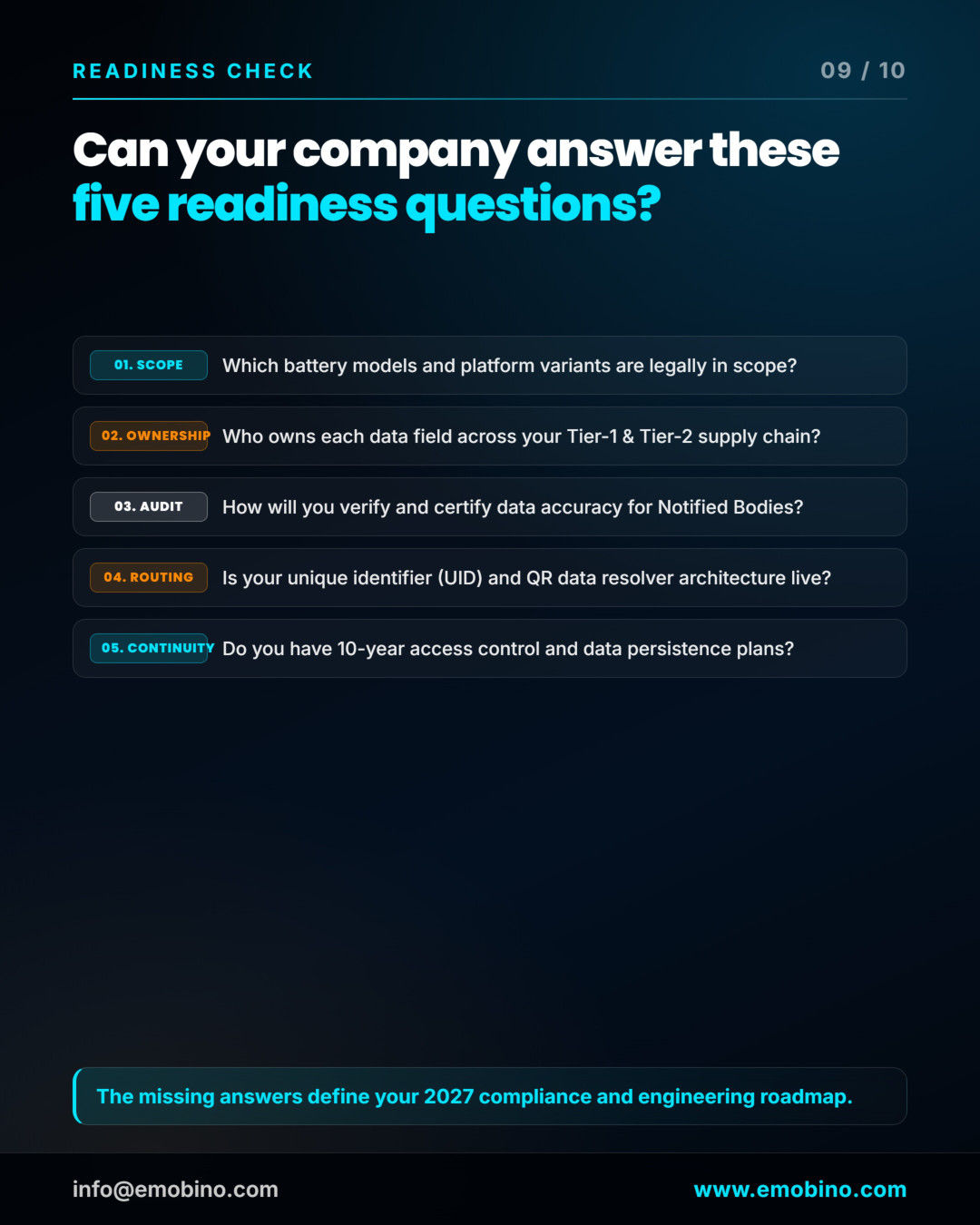
Five questions that decide your readiness
- Scope. Which battery models and platform variants are legally in scope, and who made that determination?
- Ownership. Who owns each data field across your Tier-1 and Tier-2 supply chain, and is that written into a contract or assumed?
- Audit. How will you verify and certify data accuracy for a Notified Body, and what happens when a supplier number cannot be substantiated?
- Routing. Is your unique identifier and QR data resolver architecture live, or still a slide?
- Continuity. Do you have ten-year access control and data persistence plans, including what happens if a software vendor disappears?
If you cannot answer all five today, the missing answers are your 2027 roadmap. That is not a failure. It is the actual starting point, and it is more useful than a procurement decision made before the gaps are known.
Where this usually goes wrong
Most programmes fail for the same reason. They start as a software purchase.
A vendor demo is a comfortable first step because it produces a visible deliverable. But a passport platform cannot invent data that your supply chain does not produce, cannot assign ownership your contracts do not define, and cannot certify accuracy nobody has verified. Buying the tool first means paying to automate a process that does not exist yet.
The sequence that works is the opposite. Establish scope. Map every required data field to a named owner. Fix the contracts that make that owner accountable. Verify that the data can be substantiated. Only then choose the platform, because by that point you know what it has to do.
For manufacturers outside the EU, one additional point matters. The obligation follows the product into the market, which means importers and their EU representatives inherit responsibility for data they did not generate. If you are exporting into Europe, your readiness depends on suppliers who may have no regulatory exposure of their own. That gap has to be closed contractually, and it takes longer than any technical integration.
2027 readiness starts with data, not with buying software
eMOBINO brings EU regulatory compliance, battery engineering and industrial data architecture to the same table, because these three are usually handled by three teams that do not talk to each other until something fails an audit.
If you want a direct technical gap analysis for your battery platforms, we run a 30-minute Battery Passport readiness review for battery OEMs, pack assemblers and international importers.
info@emobino.com
References
Regulation (EU) 2023/1542 on batteries and waste batteries. Article 13 (labelling and marking), Article 77 (battery passport), Annex XIII.
Regulation (EU) 2024/1781 establishing the Ecodesign for Sustainable Products framework (ESPR).
Commission Implementing Regulation (EU) 2026/1778 of 16 July 2026, laying down the implementation arrangements for the Digital Product Passport registry. Published 17 July 2026, in force 6 August 2026.
European Commission DPP Registry, operational since 20 July 2026.