
There is a business hiding inside every electric vehicle on the road, and almost nobody is building it yet. We are convinced that advanced battery diagnostics and repair will become one of the most important service industries of the next decade, that it will grow faster than almost any other part of the electric vehicle aftermarket, and that within two to five years it will have its own dedicated centres, its own trained workforce and its own supply chain. This is not a prediction we make lightly. It comes from seventeen years of opening packs that other people had declared dead, and from the numbers below.
Today the high-voltage battery is the most valuable, most complex and least serviced component in the car. Up to 40% of the vehicle's value sits in a sealed box that, when it fails, is replaced as a whole or condemns the car to the scrapyard. That is the state of the art in 2026. It will not be the state of the art in 2030.
Why we are convinced
The parc is about to age. Europe's electric fleet was small until 2020 and has grown steeply since: battery-electric cars took 17.4% of EU registrations in 2025 and 21.7% in the first eight months of 2026. The cars sold between 2020 and 2023 will leave their eight-year battery warranties between 2028 and 2031. Türkiye's electric car parc passed 465,000 in July 2026, from about 373,000 at the end of 2025, most of it under three years old. Vietnam's electric two-wheeler fleet runs on shorter warranty cycles and gets there sooner. Every one of those vehicles will one day face the question: repair the battery, or scrap a working car.
The economics are absurd and cannot last. Thatcham Research's blueprint of March 2026 describes a three-year-old electric car with a minor side impact on a battery bracket. The mandated procedure demands a new pack that costs more than the car, so the insurer writes it off. Battery issues are the top concern for 44.6% of insurers and 41.7% of repairers in the United Kingdom. Whenever a repair that should cost a fraction of the asset instead destroys the asset, a market forms to fix the gap. It always has.
The faults are repairable. Inside a failed pack, the problem is almost never the chemistry and almost never the whole pack. It is one weak cell, one module with a high-resistance joint, a cracked busbar, a contactor, a sensor, a coolant leak, a BMS board, a bracket or a seal. Our recall analysis of October 2026 found that in 21 of 39 fire-risk recalls the defect was a production fault in a cell, and the remedy in most of those cases was a module or cell replacement, not a new pack. A battery pack is built from modules. What was assembled can be disassembled, tested and rebuilt, if someone has the diagnostics, the procedure and the trained hands.
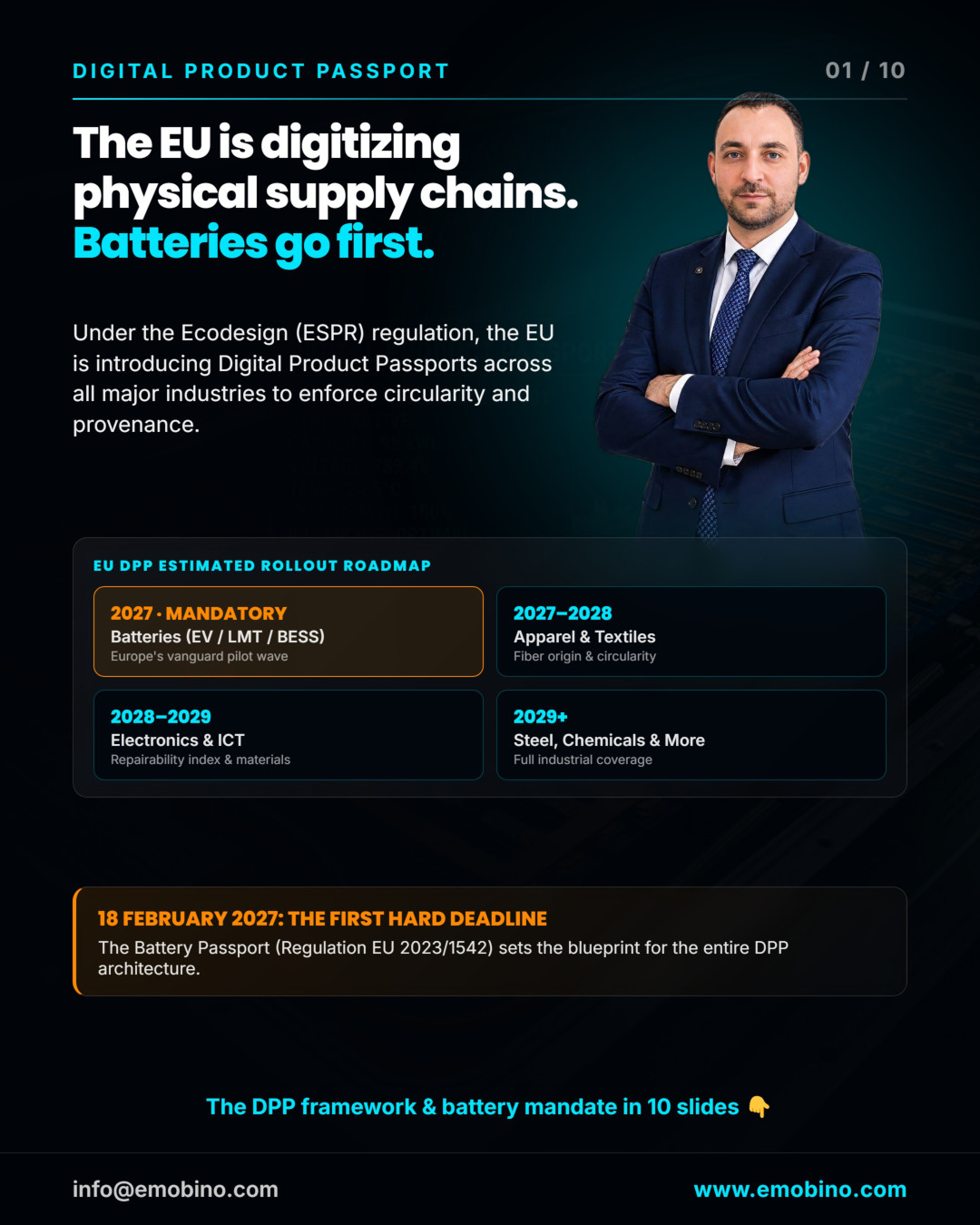
Regulation is handing over the data. From 18 February 2027, every EV battery placed on the EU market carries a battery passport under Regulation 2023/1542, and Article 14 obliges the battery management system to hold state-of-health and lifetime data and to give read-only access to the owner and to independent operators acting for the owner. Euro 7 makes battery durability a type-approval quantity for new vehicle types from 29 November 2026. For the first time, an independent centre will be able to read what the battery knows about itself. Diagnosis stops being a dealer privilege and becomes a service anyone qualified can sell.
The race has already started
Anyone who thinks this is a distant trend has not read the news of the last twelve months.
- In August 2026, CATL, the largest battery cell maker in the world, turned its after-sales unit into a separate service company and brand, opened ten directly operated battery service centres on a single day, two of them outside China in Istanbul and Oslo, and announced 100 cities by the end of 2026 and 10,000 locations by 2030. In September it opened an 8,000 square metre centre in Norway as a training hub for Europe. Its centres serve every brand, not only vehicles with its own cells. When the company that makes more cells than anyone else decides that repairing them is a business worth a global network, the argument is over.
- A European vehicle group began selling remanufactured high-voltage batteries for most of its battery-electric and plug-in hybrid models in September 2026, with the same warranty as a new original part.
- Several vehicle makers in Europe and Türkiye have stated during 2026 that they intend to move from pack replacement to cell and module repair for vehicles out of warranty, with specialised centres planned. These are still statements of intent, and the centres and procedures behind them have not been published. The intent itself is new.
- A leading supplier of workshop equipment presented high-voltage battery repair training and tooling at the Frankfurt aftermarket fair in September 2026. In the United Kingdom a remarketing group built the country's largest battery repair facility. An independent diagnostics company raised 30 million euros in February 2026 on more than 550,000 battery tests sold.
Each of these is a company decision. Together they are the outline of an industry: a parts and remanufacturing supply, a training and tooling supply, large repair facilities and a network model that separates the repair business from the cell business. In 2026 the pieces exist. In 2028 they will be connected.
What the industry will look like
We expect the battery service centre of 2028 to 2031 to be as recognisable a business as a transmission specialist was in 1990, and we expect it to be organised like this.
- Diagnosis before disassembly. The centre reads the BMS log and the passport data, runs impedance and capacity tests at pack level and locates the fault to a module before the first bolt is turned. Teardown without diagnosis is what makes repair uneconomic today, and it will be the first thing to disappear.
- Three repair tiers. Tier one, no pack opening: contactors, sensors, connectors, cooling, enclosure and bracket repair, software. Tier two, pack opened: module replacement, busbar and seal repair, BMS board replacement, re-balancing. Tier three, deep repair: cell replacement inside a module, cell-to-pack structures, re-potting. The first two tiers will carry most of the volume. The third will be done in a few regional centres with cell-grade clean rooms.
- Validated procedures per pack family, with a defined post-repair test, so that an insurer and a type-approval authority accept the repaired pack. This is where vehicle makers' remanufacturing programmes and independent networks will meet, and sometimes clash.
- A parts and second-life chain. Modules from scrapped vehicles graded and resold, used packs tested for stationary storage, cells sent to recycling with a known history. The passport makes the grading auditable.
- Mobile units for fleets. Delivery vans, buses, e-motorcycle fleets and taxis cannot lose a vehicle for a week. A mobile diagnostic and tier-one repair unit will be a standard fleet service.
The scarce resource will not be equipment. It will be people. The UK's professional body counted 71,942 EV-qualified technicians in early 2026, 26% of the total, and projects a shortfall of more than 44,000 by 2035. Türkiye and Vietnam have no comparable count at all, which is itself the finding. The companies that train the technicians will own the industry.
What we would do now
Three years is not a long time to build a centre, write the procedures and train the people. Our recommendation depends on where you sit.
- Vehicle makers and importers must decide whether the out-of-warranty battery business will be done by their own network, by a cell maker's network or by independents. The 2027 passport removes the option of doing nothing, because someone else will read the data. We would start with a repair procedure and a post-repair test for the two or three highest-volume pack families.
- Pack and BMS engineers should design the next generation for repair: module access without destroying the enclosure, BMS logs that record fault history in a readable form, cell-to-pack structures with a defined deep-repair route. Repairability will be a cost line in the next tender.
- Insurers and fleet operators should demand a diagnostic report before accepting a write-off, and contract with a centre that performs tier-one and tier-two repairs under a defined procedure.
- Investors and workshop groups in Türkiye, the Gulf and Southeast Asia have a window of two to three years to build the centres before the warranty cliff arrives. The template exists. The first player with deep pockets is already rolling it out in Istanbul.
Advanced battery diagnostics and repair will be a trade of its own within five years, with dedicated centres, tiered procedures and a parts chain. The only open question is who builds the centres in each market, and whether the local industry builds them or watches someone else do it.
eMOBINO works on battery system engineering, state-of-health estimation, failure and risk investigation and the technical assessment of battery service operations. Our founder, Mustafa Şimşek, has worked on battery and vehicle programmes since 2009 and has led root-cause investigations on field failures of high-voltage packs. If you are planning a battery service centre, a repair procedure for a pack family or a diagnostic capability for a fleet, we can help you design it.
Sources
- CATL, launch of its after-sales service brand and 100-city plan, as reported by CarNewsChina (14 August 2026) and electrive (5 October 2026); Norway centre opening, PR Newswire (24 September 2026).
- Thatcham Research, EV Blueprint (3 March 2026), as reported by Automotive World and Insurance Edge.
- ACEA, new car registrations 2025 and January to August 2026.
- EPDK figures on the Turkish electric vehicle parc, as reported by Cumhuriyet (3 October 2026).
- Regulation (EU) 2023/1542 on batteries, Articles 14 and 77 and Annex VII; Euro 7 Regulation (EU) 2024/1257 and UN GTR 22 on battery durability.
- electrive, remanufactured high-voltage batteries (4 September 2026) and battery diagnostics provider financing (11 February 2026).
- Vehicle maker statements on cell and module repair after warranty, European and Turkish trade press (June to September 2026).
- Institute of the Motor Industry, EV technician data (February 2026).
- eMOBINO, EV Battery Recalls for Fire Risk 2025 to 2026 (October 2026).