
The European Commission updated its guidance on battery passport data points on 19 October 2026. The document is now Version 3.2, third edition. The passport still becomes mandatory on 18 February 2027, and the guidance creates no new obligation. It does clarify how the data is expected to look, and three of the changes land on the BMS and test side.
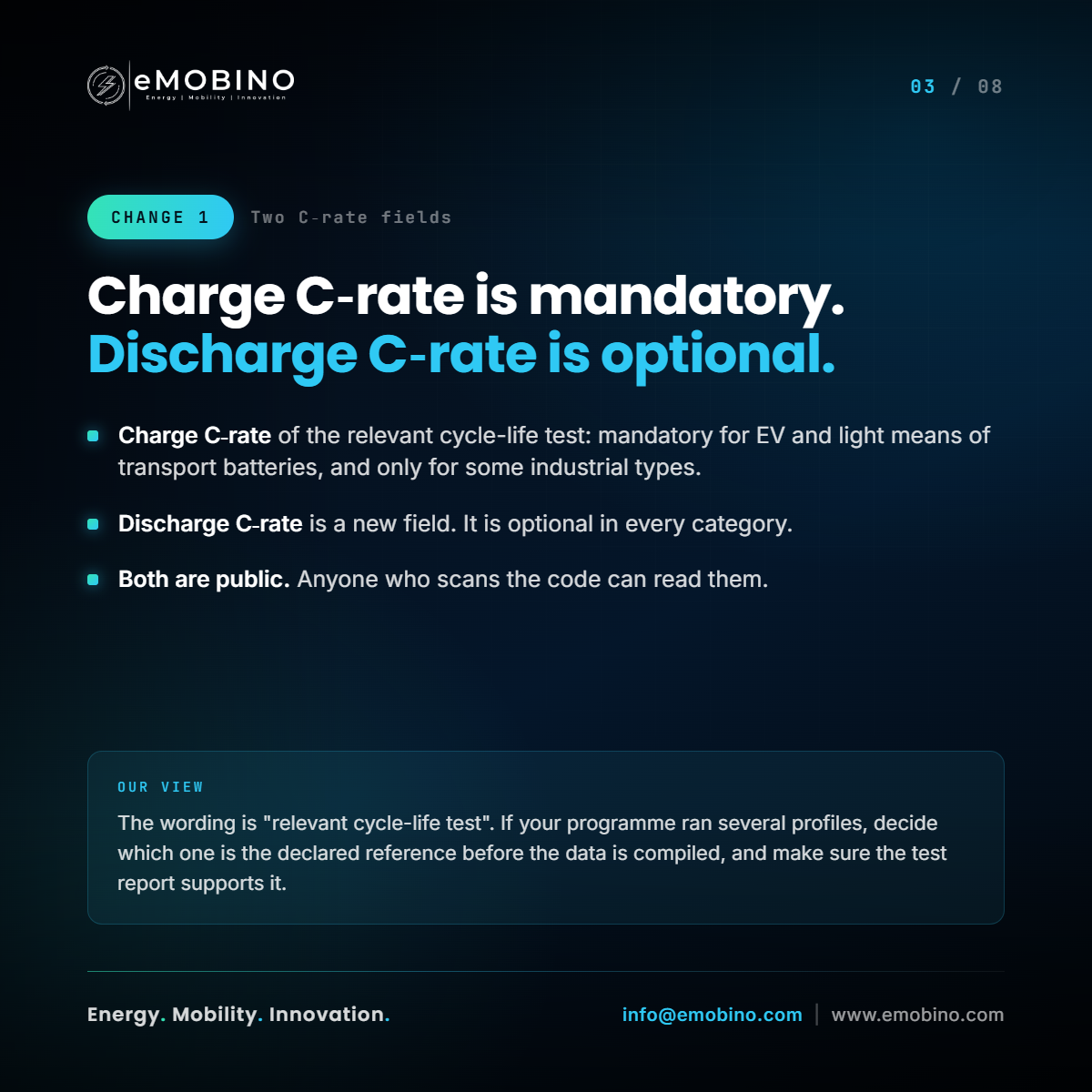
Charge C-rate is mandatory, discharge C-rate is optional
The guidance now lists two separate fields for the C-rate of the relevant cycle-life test. Charge C-rate is mandatory for EV and light means of transport batteries, and applies only to some industrial battery types. A new field for discharge C-rate is optional in every category.
The wording is "relevant cycle-life test", and that is the part worth reading twice. If your cycle-life programme ran several profiles, someone has to decide which one is the declared reference, and the test report has to support that choice. We would fix this decision now, before the passport data is compiled, rather than after a supplier question arrives. Filling in the optional discharge value costs little and removes a question later.
Temperature and state of charge history are histograms, and access is restricted
Data points 70 and 71, the operating temperature and state of charge history, are defined as histograms. Both are restricted: only persons with a legitimate interest see them, and they apply from the moment the battery starts to be used.
For a BMS this is a design decision, not a reporting detail. A histogram can be built from stored bins instead of raw logs, which keeps memory and synchronisation load small. A pack that only keeps raw data, or only a lifetime average, has to be reworked before it can fill these fields. As we wrote in September, periodic synchronisation is sufficient. A live stream is not required.
Who sees the restricted data is still being decided
The guidance adds access for Member State authorities and notified bodies to several data points, and it states for each field whether it is public or restricted. The harder question is who the persons with a legitimate interest are, such as repairers, remanufacturers and recyclers. The implementing act that defines them missed its 18 August 2026 deadline. A draft has been reported, with adoption expected around the turn of the year, but we treat those dates as unconfirmed until the official notice is checked.
Until the act is adopted, the access rules for the restricted fields are provisional. That is a reason to build access control as a configurable layer, not a fixed list of roles.
What we would do this week
- Decide which cycle-life test is the declared reference, and write down its charge and discharge C-rate.
- Check whether the BMS can produce temperature and state of charge histograms from stored data.
- Map the merged and renumbered fields (data points 46 to 49) against your supplier data sheets.
- Keep the access control layer configurable until the implementing act is final.
The 2027 date did not move. What moved is the level of detail teams are expected to deliver.
If you want a second pair of eyes on how your BMS data maps to the passport fields, write to info@emobino.com.
The full carousel